

Why your blender can be a sugar liberator
You think you’re making a healthy choice. You grab a fresh fruit, maybe some spinach. Then into the blender it goes.
But here is how blending may affect your blood glucose response.
Mechanical Shearing Action
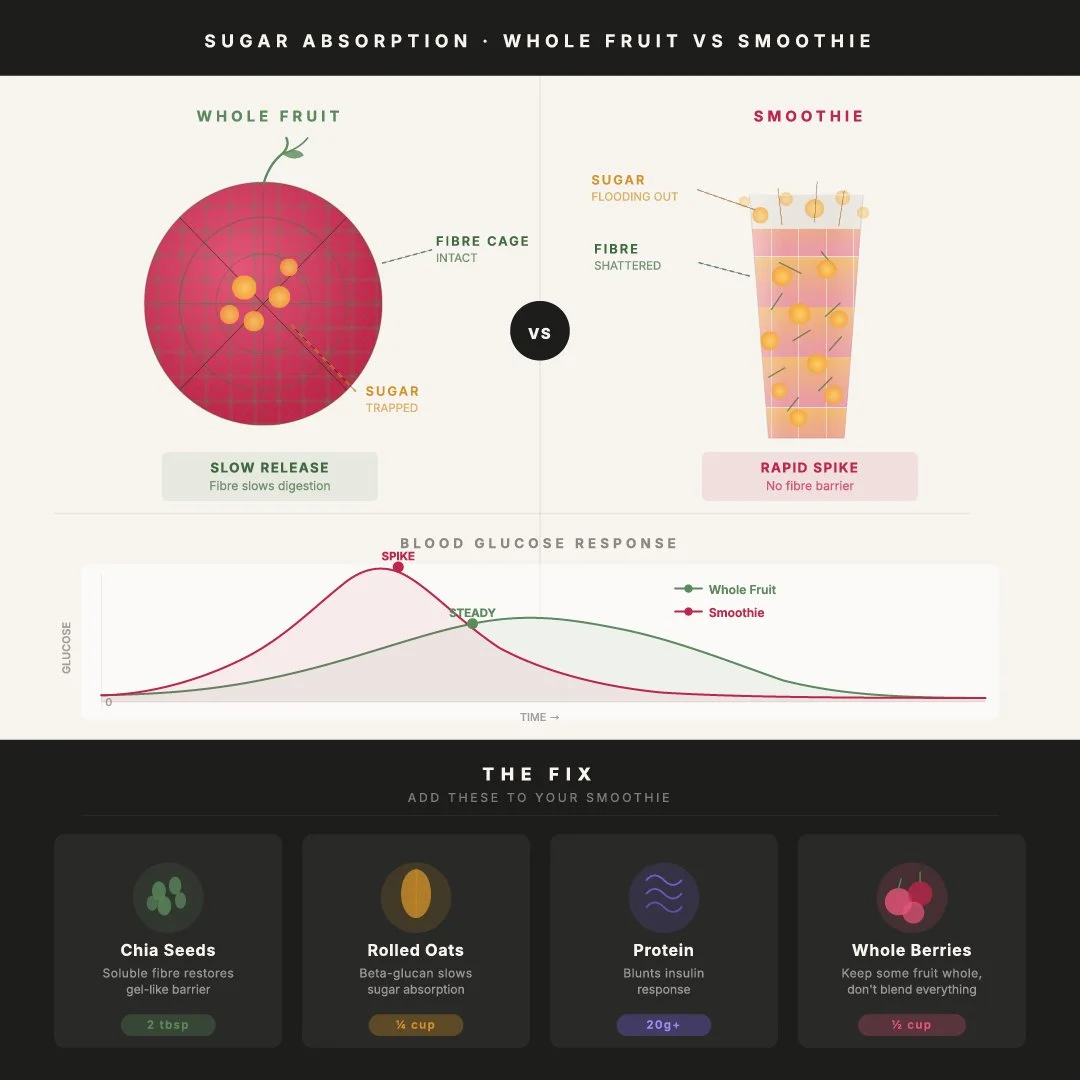
In fruits such as apples, berries, or mango, sugars and other carbohydrates are contained within plant cells. These cells are wrapped in fibre-rich cell structures that act as a natural scaffold. Think of it as a net holding fish in place.
You chew your food slowly when you eat whole fruits. Many of these plant cell structures remain partially intact, allowing sugars to be released more gradually during digestion.
When you blend at thousands of revolutions per minute (RPM), the blades cause shearing action. That means they mechanically break down plant cell walls. The net breaks. The fish swim out at once.
Blending can make carbohydrates more accessible to digestive enzymes, which break them down into glucose. This leads to faster absorption, allowing glucose to enter the bloodstream more quickly.
You could think of this as a ‘blender effect’ -- where breaking down the food structure makes carbohydrates easier to digest.
If your Discovery results showed a spike difference between whole fruit and a smoothie, this is likely why.
Insoluble and Soluble Fibre: The Two Brakes
Whole plants give you two types of fibre: soluble and insoluble fibres.
Insoluble fibre does not dissolve in water. It increases volume. It acts like a physical ‘cage’ within the food, slowing how quickly digestive enzymes can reach the carbohydrates.
Soluble fibre dissolves in water and creates a gel in your digestive tract. The gel slows gastric emptying (how fast food exits your stomach) and delays glucose absorption.
Blending breaks down plant cell structures and reduces the size of the food particles. Soluble fibre can still form a gel, but the overall food structure that helps slow digestion may be diminished.
The Thermal Spectrum: When Heat Softens the Armour
Blades aren’t the only sugar liberators. Heat can do something similar.
Starch is a storage form of glucose found in rice and noodles. When starch is heated in water, its granules swell and break apart. This process, called gelatinisation, softens the starch and makes it easier for digestive enzymes to access. The longer it is heated, the more easily the starch can be broken down.
This is why congee often raises blood sugar faster than the same amount of intact steamed rice.
Texture is your clue. The softer and more broken down the food, the less mechanical and digestive effort your body needs to break it down. Your digestion speeds up.
The same logic applies to very soft noodles soaked in gravy or overcooked rice.
The Insulin Response: The Rollercoaster
When pulverised or heavily softened food reaches your small intestine quickly, glucose enters your bloodstream quickly too.
Your pancreas responds to this rush of glucose by producing a burst of insulin, a hormone that moves glucose from your blood into your cells.
A large, rapid rise in glucose may trigger a larger insulin release. This can sometimes be followed by a dip which can feel like sudden hunger. Or brain fog. Or a craving for something sweet.
The Rescue Hack: Add Anchors
You don't have to be afraid of your blender. If you enjoy blending your meals or making smoothies, you can rebuild some ‘structure’ by adding these anchors after blending.
Adding these afterward preserves their texture and helps slow digestion, which can moderate the rise in blood sugar:
Chia seeds or psyllium husk (extra fibre)
Unsweetened nut butter or avocado (healthy fats)
Plain yogurt or protein powder (protein)
You can try experimenting with texture in other foods:
Choose steamed rice over congee when possible.
Try slightly firmer noodles or pasta.
Explore mixed or whole grains instead of refined ones.