

How to stop naked carbs from hijacking your energy
You have experienced this feeling before.
A steaming plate of white rice at the hawker centre.
White toast with jam.
Instant noodles.
You feel full but then a few minutes later, you are searching for a snack.
That is not a lack of willpower. That is a buffering issue.
Your Stomach is a Holding Cell
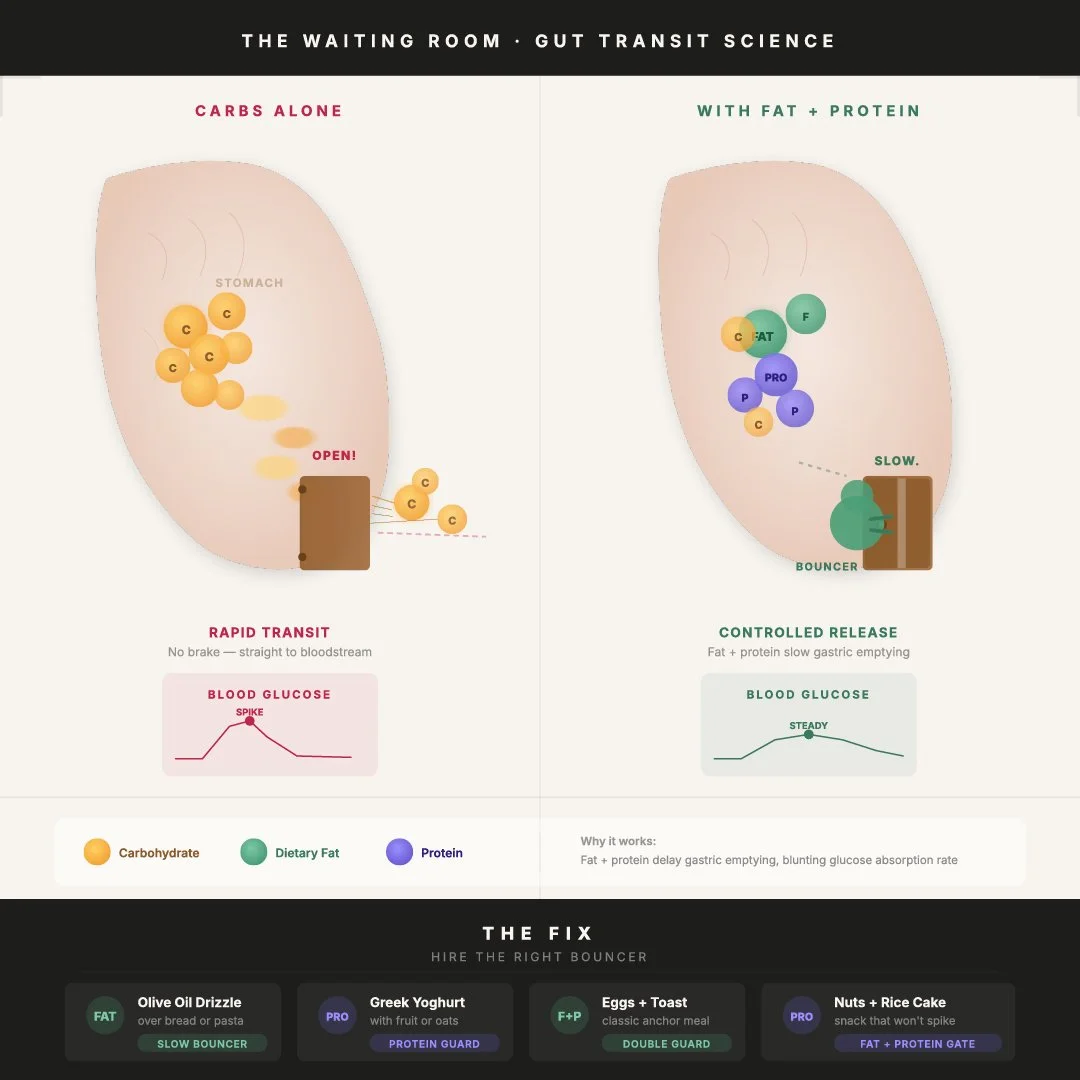
Think of your stomach as a holding cell. On the other side of the holding cell there is a small muscular valve called the pyloric sphincter, which acts like a gate keeper. The gate keeper controls the speed at which food passes into your small intestine where most of the glucose is absorbed.
Simple carbohydrates such as white rice or white toast with jam pass through very quickly.when they are consumed alone.
Fat and protein slow down the passage of food by sending signals to the gatekeeper telling him to open slowly. When liquids and refined carbohydrates are consumed, the gate opens even wider.
As soon as simple carbohydrates enter the stomach alone, your glucose levels may increase rapidly.
That’s the Naked Carb Test in action.
The Enzymatic Traffic Jam
Your body utilizes enzymes to break down your food. Enzymes are specialized proteins that function like scissors.
Amylase cuts carbohydrates into glucose.
Protease cuts protein into amino acids.
Lipase cuts fat into fatty acids.
When carbs are consumed alone, amylase gets to work immediately.
When carbohydrates, fats and protein are consumed together, all three enzymes must be utilized at the same time and digestion slows. It becomes a traffic jam. Digestion slows and glucose enters your bloodstream more gradually. This combination may lower peak glucose levels when compared to consuming carbohydrates alone.
Not blocked, just buffered.
The Satiety Signal
Fat and protein do something else important. They trigger satiety hormones, chemical messengers that tell your brain you’re full.
Three key ones:
GLP-1 (glucagon-like peptide-1), which slows gastric emptying and helps regulate blood sugar
CCK (cholecystokinin), which promotes fullness
PYY (peptide YY), which reduces appetite
Carbs alone trigger less of this signalling. That’s why a plain apple may leave you hungry later. An apple with peanut butter would be a different story.
This is also why the Avo Shield works. When you spread avocado onto white toast or add an egg to your noodles, you increase satiety.
The Pairing Rule
Here's the easiest rule to follow throughout this entire guide: For each portion of carbs (fist size), add a thumb size portion of fat or a palm size of protein.
Example:
Fist = rice, noodles, bread, fruit
Thumb = nut butter, cheese, avocado
Palm = chicken, fish, firm tofu, egg
Other examples that you may already be familiar with:
Roti prata → add egg
White rice → add tofu or grilled fish
Instant noodles → add an egg or edamame
Fruit → combine with plain Greek yogurt
Never consume carbs naked.
The Label Trap
Food marketing can confuse you.
“Low-fat” yogurt often replaces natural fat with added sugar.
“Fruit-on-the-bottom” can mean syrup at the bottom.
“Whole grain” cereal bars may still contain added sugar like glucose syrup.
Fat isn’t the villain here. In the right amount, it serves as your buffer.
Read labels. Check for added syrups. Sometimes, the best choice is the full-fat plain yogurt.
What You Can Do Today
At your next meal, apply the Thumb Rule.
Look at your carbs and ask “Where’s the buffer?” Add one thumb of protein or fat. Then notice your energy two hours later.
You’re not just eating for fullness. You’re building stability into your day.